
Safer sleep · 5 min read
Safer sleep, clearer guidance.
Understanding SIDS, other sleep-related risks, and the everyday steps that help create a clearer space for rest.
Start with understanding, not fear.
Sleep advice can feel confusing when a family is tired, receiving different suggestions, and working with the space available at home. Clear information should help parents and everyone around them make practical decisions. It should not turn a conversation about care into blame or suggest that buying a particular product guarantees safety.
This article draws on the US National Institutes of Health Safe to Sleep campaign, which explains recommendations based on the American Academy of Pediatrics. The guidance concerns infant sleep; it is not a description of Nigeria’s newborn mortality rate. A baby’s health worker can help a family discuss individual needs, including care for a baby born early or with a health condition.
Safer sleep: ways to reduce a baby’s risk (opens in a new tab)
SIDS is not the name for every infant death.
Sudden infant death syndrome (SIDS) describes the sudden death of a baby younger than one year that remains unexplained after a full investigation, including the medical history, a post-mortem examination, and the circumstances of the death. It is a specific classification, not a label that can be applied simply because a baby died during sleep.
Sudden unexpected infant death is a broader term. It includes deaths whose cause is eventually identified as well as deaths that remain unexplained. Accidental suffocation, for example, is different from SIDS even though both can be discussed when considering sleep-related risks.
Neonatal mortality is different again: it describes deaths from any cause in the first 28 days of life. SIDS concerns babies under one year, so the terms cover different time periods as well as different causes. US sleep-related death statistics should not be presented as Nigerian figures. Here, the focus is the guidance and its practical meaning, not an unverified local SIDS estimate.
NIH: what SIDS means, and how it differs from other infant deaths (opens in a new tab)
The core routine: back, firm, flat, and clear.
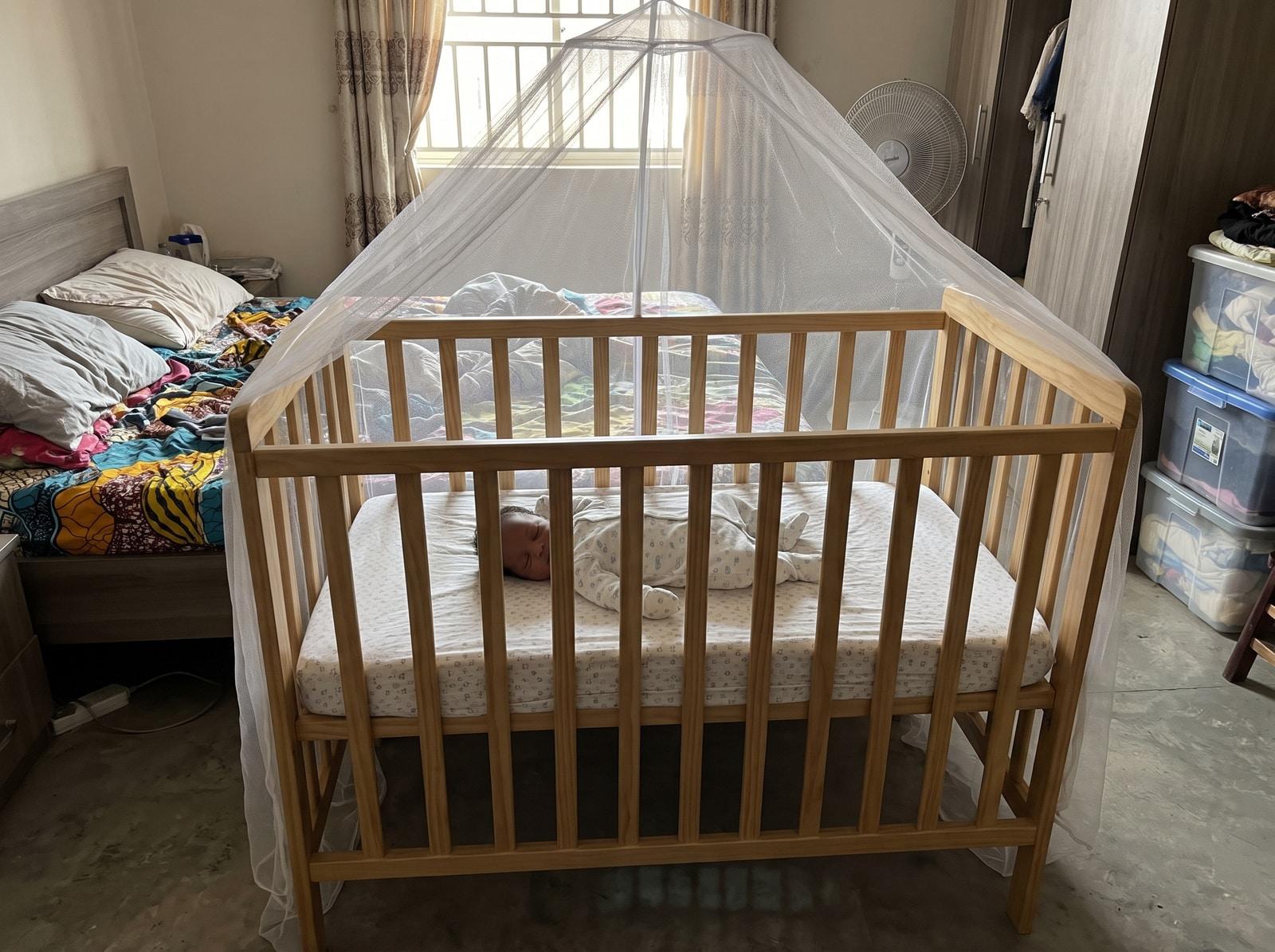
NIH recommends placing babies on their backs for every nap and night-time sleep, on a firm, flat, level sleep surface in a cot, bassinet, or other infant sleep space that meets applicable safety standards. The mattress should be covered only by a fitted sheet. Side sleeping is not a safer alternative to back sleeping.
The reason for a clear space is simple: pillows, loose blankets, toys, padded bumpers, and other soft objects can obstruct breathing or create entrapment and strangulation risks. A cot can look bare to an adult and still be a more suitable sleep environment for a baby. Spare clothes and cloths belong outside it, ready for changing and washing rather than stored around a sleeping infant.
- Place your baby on their back for every sleep.
- Use a firm, flat, level mattress covered only with a fitted sheet.
- Keep pillows, loose blankets, toys, and other soft items out of the sleep space.
- Keep your baby’s head and face uncovered and dress them for the room temperature.
Safer sleep: ways to reduce a baby’s risk (opens in a new tab)
NIH: a safer sleep environment for babies (opens in a new tab)
Close enough to care, in a separate sleep space.
Room sharing means a baby sleeps in the same room as a parent or caregiver, but on their own infant sleep surface. NIH recommends room sharing for at least the first six months. Having a cot or bassinet nearby can make checking, feeding, and comforting easier without making an adult bed the baby’s regular sleep space.
Feeding and settling often happen when adults are exhausted. After feeding or comforting, return the baby to their separate sleep space before you go to sleep. Sofas and armchairs are especially dangerous places to fall asleep with a baby. If you do fall asleep while feeding in bed, move the baby back to their own sleep space as soon as you wake.
These conversations are most useful when they acknowledge real homes and tired caregivers. A partner, grandparent, or other trusted person can help with the surrounding tasks, and all regular caregivers should understand the same sleep routine.
NIH: a safer sleep environment for babies (opens in a new tab)
Warmth does not mean more bedding.
Clothing and blankets have everyday uses, but offering an item as an everyday essential does not make it suitable to leave in a cot during sleep. NIH recommends avoiding overheating, keeping a baby’s head and face uncovered, and using suitable sleep clothing rather than loose bedding in the sleep space.
Swaddling is not a way to prevent SIDS. If a family swaddles, back sleeping still matters, and swaddling should stop as soon as the baby shows signs of trying to roll. Weighted swaddles and weighted blankets are not recommended. Choosing an appropriate routine is about the baby’s development and the environment, not making a sleeping space look cosy for a picture.
The same guidance recommends a smoke- and vape-free environment. It also advises against monitors, wedges, or other products marketed as a way to prevent SIDS. No product can make that promise.
Safer sleep: ways to reduce a baby’s risk (opens in a new tab)
Why information belongs beside essentials.
For RootedRibbons, safer-sleep information belongs alongside everyday essentials in community settings. A useful explanation should show the difference between items for washing, changing, and supervised care, and what belongs in a baby’s sleep space. Guidance is more helpful when it is understandable to the people who will actually care for the baby.
These recommendations reduce risk; they cannot remove every risk or explain an individual family’s loss. Compassion matters as much as clarity. Our role is to share dependable information and encourage questions with health workers, while keeping the focus on everyday care rather than product claims or fear.